Norseman Xtreme Triathlon Race Recap
Updated: 6 days ago
I came for the black shirt. And I got the black shirt. A goal I set for myself seven years ago was accomplished. Three weeks removed at the time this article is published, and it still seems hard to believe.
Before I get into it, let me give you a little history of how we got here.
When I finished Kona in 2019, I checked all the boxes I had for myself in triathlon at the time. I loved the sport and still wanted something to chase or challenge myself. Kona is the mecca of triathlon and I didn't know what else was out there.
A couple months later, I came across an article about some crazy ass race in Norway called Norseman, and how it’s widely regarded as one of the world’s hardest triathlons. The distances are the same as an Ironman, but that’s pretty much where the similarities end.
The race is small. 250 athletes total, compared to 2,000+ in a normal Ironman. Athletes jump off a ferry into a fjord in the dark with water temps usually in the mid-50s for a 5am start. It's a 500-600 yard swim just to get to the start line from the ferry. The bike and run courses climb a combined 17,000 feet with weather that’s highly unpredictable, and can change drastically throughout the race. The course is point-to-point and goes through rugged and mountainous terrain that remains mostly untouched. Way more often than not, you’re by yourself on the course.
The entire race is self-supported. There are no aid stations like a traditional triathlon. You need to have an awesome partner and/or some rad friends (I’m incredibly lucky to have both) be your support crew and follow along the course all day to provide your nutrition and gear you'll need for the whole day.
If you’re within the first 160 athletes to get to the checkpoint at mile 23 on the run within a cut-off time, you get to finish on top of Mount Gaustatoppen and earn one of the most coveted and respected awards in endurance sports - the black Norseman finisher shirt. If you’re athlete 161 or later, or miss the cut-off, you finish at an alternate location and get a white shirt. No finisher medals. Just a shirt. I’ll also note here that simply finishing Norseman, regardless of the color of your shirt, is an incredible accomplishment. Even stepping onto the ferry and jumping into the fjord’s cold waters is something that not many Ironman finishers are willing to attempt.
Ironman’s slogan is “Anything is Possible”. Norseman’s slogan is “This Is Not For You”.
After reading that article, I thought to myself, “This seems sufficiently crazy. Let’s go after that.” I now had another checkbox to fill - the Norseman black shirt.
Entry into the race is also hard. Around 9,000 athletes try to get one of the 250 available slots every year. There are three ways to get a slot:
Finish first or second overall at a qualifying XTri race. There are no age groups in XTri.
Earn X-Points and put your name in ahead of the lottery. The top 100 athletes with the most points get in.
Enter the lottery for one of 125 slots. Around 8,000 people enter the lottery, so the 0.01% odds of your name getting pulled aren’t good.
I raced Starvation XTri three times trying to get an automatic slot (#1 above), just missing each time finishing 4th, 4th and 3rd. But with the points earned in those races, along with a handful of other challenges XTri puts on throughout the year, I attained enough points to get in (#2 above). When I got the email last October that I had enough points for this year’s race, it hit me that I’d get to jump off the ferry and take on this legendary race after seven years of having it in my sights.
I’m lucky that I live in Boulder and have easy access to lots of big climbing, both biking and running. And having raced Starvation, I felt I had some solid experience at extreme triathlons. So I at least felt confident that I had the preparation and fitness to take on the bike and run courses, from a course profile perspective.
What had me anxious (and scared) going into Norseman was the water. I can’t handle cold water very well, due to some frostbite I got while skiing. On really cold days (say 15° and below), my hands get very painful, even with heavy gloves on. My temperature limit for a two-minute cold plunge is around 55 degrees. I’ve never swam in water as cold as what we’d be in that fjord. And not being a strong swimmer, I’d be in the coldest water I’ve ever swam in for well over an hour. Leading up to the race, Norseman’s medical team sent out a few articles about what happens to the body physiologically during and after the race (all of those articles are linked at the bottom if you’re interested in learning more about that). The article about what the water actually does to you got me particularly anxious.
“Would there be a point where the cold water was too painful to continue swimming?” “Will I have functional use of my hands to get my wetsuit off and get my bike gear on in T1?” “Will my core body temperature drop to a point where cognition becomes compromised?” These were the questions I was asking myself in the weeks leading up to the race.
I got to Norway Monday night of race week. In case anything happened to my bike during travel, I wanted a few extra days to take care of it in Bergen, where there are bike shops, before heading out to Eidfjord, where there are not. I built my bike the next morning with no issues.
I got out to Eidfjord on Wednesday late afternoon after an absolutely beautiful drive out from Bergen. Eidfjord is very small, with a population around 500. You can walk from one end of town to the other in about five minutes. But it’s picturesque, sitting at the end of a spectacular fjord.


There was a practice/social swim on the race week activities calendar for Thursday morning. This was the first time I’d get a chance to feel the water. Hardangerfjord is the fifth-longest fjord in the world and the second-longest in Norway, stretching about 110 miles from the Atlantic Ocean into the mountainous interior of Vestland county. As I mentioned above, the cold water is where I had the most apprehension coming into this race. Our team’s wetsuit sponsor, Sailfish, hooked me up with some cold water gear - a thermal wetsuit, neoprene gloves, booties and cap. (Huge shoutout to Ryan Dolan at Sailfish for help getting this gear). When I jumped in, the rumors were true. It was cold. Race officials measured it at 56°. The first few seconds take your breath away. But it was also manageable. 30 minutes in the water and I started to have confidence that race day may go ok.

There was a bonfire and group run as well in those few days before the race. It was really cool to meet athletes from all over the world. The one thing I observed in those couple days in Eidfjord before the race was the overall vibe, compared to Kona. Both are a world championship race with athletes from all over the world. In Kona, you could feel the energy in the air. The tension of 2,400 athletes in the final days before the most high profile event in our sport is palpable. Don’t get me wrong - it's rad and an incredible atmosphere, but it's a very Type A/competitive/pent-up energy feeling. (Well, except for the Underpants Run, that is. That's just good, wholesome fun).
But these few days prior to Norseman was a different energy. It was a very friendly, welcoming, supportive atmosphere. It was less a feeling of competition and more a feeling of a small group of people about to do something few would ever attempt. In a weird way, the vibe was very calming, even though what 250 of us were about to do was anything but calm.
The night before the race was a quiet evening at our rental with my crew - my wife, Kim, and three amazing friends - Allie, Px and Morris. I took a moment to appreciate each of them taking their personal time to come to this little town in western Norway to help me achieve a goal I set for myself back in 2019. I also thought of my trail buddy, Tom, who provided support and paced me each time at Starvation but couldn’t make this trip. He was definitely missed. My pre-race nerves were still amping up, but it was a confident nervous, not an anxious nervous.
Race day.
The alarm went off at 2:30 am and, like every race morning, I questioned why I participate in a sport that makes me get up at 2:30 in the morning. I got down to transition, set up my gear, gave Kim a kiss and stepped onto the ferry.
I wanted to keep warm, so I found a seat inside and chatted with a couple athletes sitting nearby, and before I knew it, an announcement came over the PA system that spray down begins in 2 minutes. You get sprayed with cold water to initiate the body’s cold shock response, so it doesn’t happen for the first time when you jump off the boat.
Standing on the edge of the boat, I took a moment to look out into the fjord. It was still dark, but the early morning light was starting to appear and the fjord looked amazing. Dark and rugged. And after seven years of seeing videos and pictures of athletes jumping off this ferry, it was finally my turn. And yes, it was cold and that initial cold shocks your system, even after the spray. I came up, took a deep breath, and started to swim out to the start line.
After the jump, I took a few looks back at the ferry as I swam out to the start line, and just appreciated being there in that fjord, at this race. As I looked back, the view of the ferry, with the giant Norseman banner, is a sight I'll never forget.
Thanks to Ariel Wojciechowski for capturing these amazing photos of the ferry and the race.


I took my time getting out to the start line because I didn't want to burn matches this early but the horn sounded before I got out there. I was still a couple hundred yards away with a handful of other athletes. Oh well. It was going to be such a long day that I didn’t think the few minutes I was behind the field was a big deal. And for the apprehension I had about the water, it actually felt good to be in it (chalk that up to adrenaline). And views of the fjord from the water as daylight got brighter were simply amazing. All in all, the swim went well. Official swim time was 1:23:23 (but that's including that extra time to get to the start line after the horn sounded). I came in about the time I expected and I wasn’t frozen. Thank you, Sailfish!
Going into the race, I thought if I came out of the water in the top 150, I’d put myself in a really good position for the rest of the day with my strength in the bike and run. I saw my crew for the first time on the bike at mile 18 and they said, to my surprise, I was around 110th place out of the water, so I felt really solid that as long as I just stuck to my nutrition plan, stayed patient during the big climbs, and executed the way I’m capable of, the black shirt was mine.
The bike course started with a 4,000’ climb in the first 20 miles through a beautiful canyon. I had been simulating this start for the 5-6 weeks of peak training, riding from my house up Left Hand Canyon to Brainard Lake. And that simulation helped. I felt strong through that climb, passing a handful of athletes. It topped out onto Hardangervidda National Park, an above-treeline plateau with an alpine tundra ecosystem. It’s also Norway’s largest national park that features some of the most beautiful and rugged landscape I’ve ever seen.


Since it’s above treeline, it’s also exposed to weather. We hit a few pockets of wind and freezing rain along the plateau, but for the most part, the weather was decent. Seeing videos of other years, I can’t complain. I was making my way through the field a bit, and was patient through the rest of the climbs, trying to conserve the legs for the run. I was feeling good, meeting my crew a few times to refill my nutrition, taking in the amazing scenery, passing a couple ski areas (Yeah, definitely need to get back here at some point to ski) and appreciating all the locals who were out cheering us on yelling “Heia! Heia!” through each village we went through. The local support and enthusiasm throughout the day was awesome. I came into T2 in good shape with a bike split of 6:34:56 and got an update that I was in 87th place.
The first 16 miles of the run is pancake flat around Tinnsjå, one of the largest lakes in Norway. I had a comfy fast pace through this stretch, and was still moving up a few spots. Around mile 12, I came around a grove of trees and got the first view of Mount Gaustatoppen. Like the view of the ferry as I swam away after the jump, seeing the top of Gaustatoppen for the first time is a sight I'll never forget. But damn, did it still look far away.
Thanks to Morris for capturing these rad pics of the run!
Mile 16 is the start of Zombie Hill. And it lives up to its name. Climbing 6,000 feet in 10 miles with an average grade of 11%, these miles are sloooooow. At this point, I was in 82nd place. Comfortably in the black shirt group and comfortably ahead of the time cutoff. The black shirt wasn’t official yet though. I still had to get to the checkpoint at mile 23. But I was still feeling good, and started to do a 1-minute run, 2-minute walk up the hill. The mountain in the background of this video is where we finish.
We were pretty lucky with the weather most of the day, but as I got up the hill, some freezing rain swept through for a little while. Miles 20-23 were long and cold. I didn’t have any layers on at this point and that cold had me shivering, even while I was running.
I met up with my crew at the checkpoint, and it was official. I was the 82nd athlete to get to the checkpoint. I’d be finishing on top of the mountain and getting the black shirt. At this point, for safety reasons, each athlete is required to have a support person accompany them up to the finish line. My awesome friend, Px, joined me for this stretch, and her positivity is infectious.
As I started up the trail, I started reflecting on my triathlon journey. There have been so many people and moments over the past 22 years that helped me get to this rugged mountain in central Norway, about to cross the finish line of one of the world’s hardest triathlons.
I thought about getting in the pool at the Bally’s in King of Prussia in 2004 and thinking I was going to drown on my third lap, and waiting six years before finally deciding to get over this fear of swimming and convincing myself I could do a triathlon.
I thought about giving Jason Klonoski a 12-pack of Busch beer for letting me borrow his wetsuit that was two sizes too big for my first triathlon in 2010.
I thought about doggy-paddling and backstroking through that first race, an olympic distance race in Park City, and how I was never so excited to touch land again at the end of the swim, and being stoked that I finished and was officially a "triathlete".
I thought about how lucky I was to have found an amazing coach in Mark Van Akkeren in 2013 who got me through my first Ironman and, year after year, pulled more ability out of me in this sport that I didn’t know I had. I wouldn’t be here if it wasn’t for a decade of his coaching.
I thought how lucky I was to join Boulder Racing and train with a bad ass group of athletes. Every year, the roster changes, but one thing that’s been consistent in my eight years on the team is that every dude wearing that kit is incredibly driven, knows how to have fun, brings out the best in each other, and genuinely celebrates each other's success.
I thought about the last 18 months after losing my job at Salesforce and the demoralizing, disheartening and discouraging experience of a job search in this market (In addition to running this business, I also have a 20+ year career in ecommerce).
I thought about dear friends that I lost over the years who had a profound impact on my life - John Shunk, Jesse Green, Kristyn (Heinle) Levine.
And of course, I thought about my mom, who passed away last February, and how proud she’d be that I accomplished this goaI. She was there for my first 70.3, my first Ironman, the first time I qualified for Kona and my first race in Europe. I know she was there that day in Norway too.
I had been seeing pictures and watching videos of this finish line for seven years. It felt surreal that I was about to cross it. As we approached it, I took those last few steps slowly to take it all in. It was cold, windy and cloudy, but I wouldn’t have wanted it any other way. After a 5:30:19 run split, and 14 hours after jumping off a ferry into a cold fjord 140.6 miles away, I was officially a Norseman black shirt finisher.


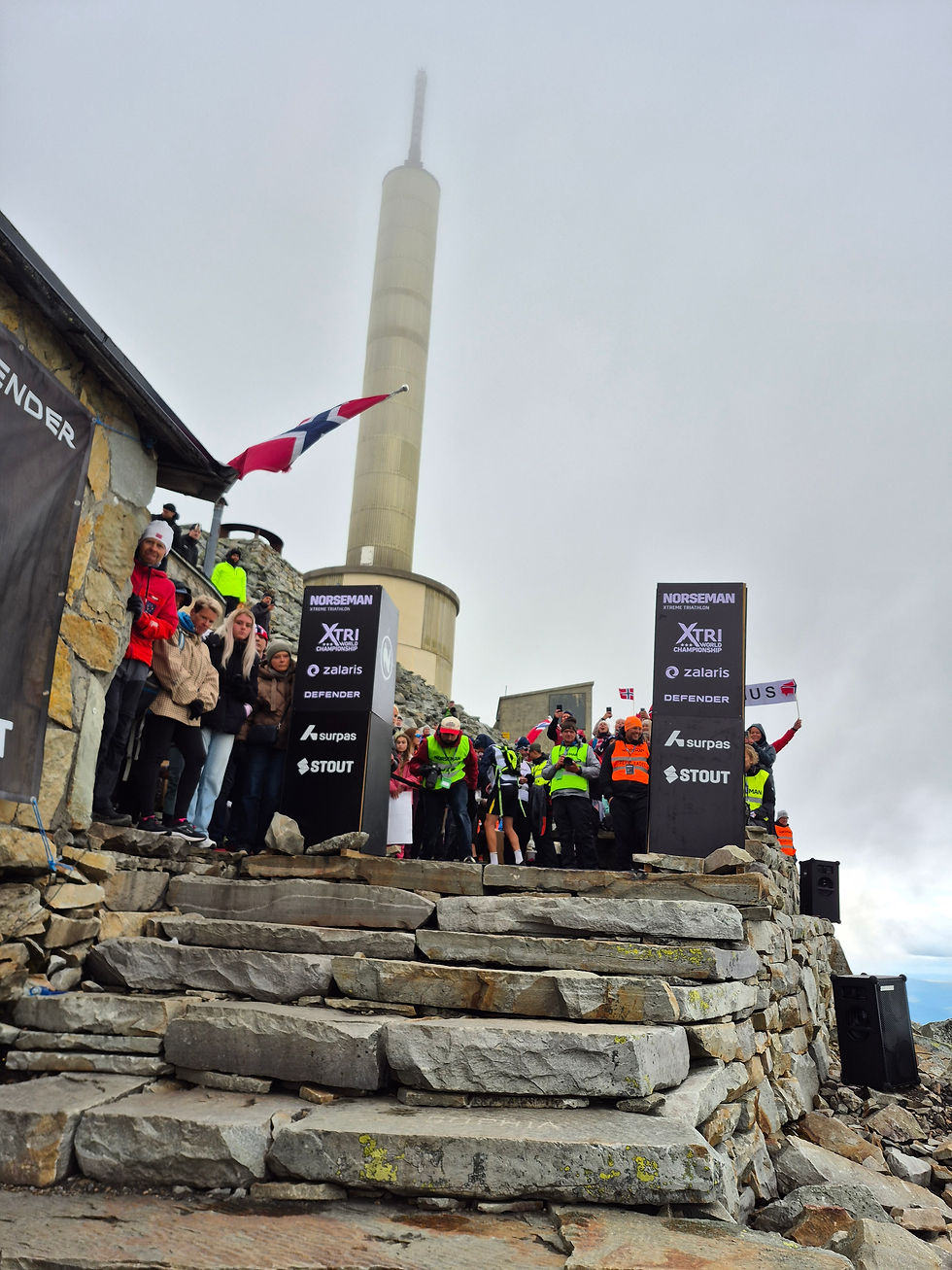
I'm not going to lie. It was emotional.
We hung out up there for a little bit, just taking in the people, the view and the aura. The mystique of this race lived up to its hype - the fjord, the ferry, the terrain, the mountain, the finish line, the vibe, the community. It was a beautifully epic day doing something few would ever attempt, and one I’ll remember for the rest of my life. And just an overwhelming feeling of how fucking lucky I am, and what a privilege it is, that I get to do this stuff. That even at 47 years old, I’m still pushing my own boundaries and past old limits.

We got our finisher shirts the next day. When I got my shirt, I went outside, sat at a picnic table and just looked at it for a few minutes before putting it on. And then went over to take part in the Norseman Class of 2026 photo.


It may sound silly or dumb to do this for a t-shirt. But it's not just a shirt. It's what that shirt represents. I’ve had a fair amount of success in triathlon and running. But trust me when I say I have no special athletic ability. I was always competent in sports that I played, but I was never a star athlete. I once made the all-star team in little league, but got cut from my high school team twice. I was captain of the wrestling team my senior year in high school, but only managed a .500 record. I ran my first marathon in 4:21 in 2005. Not bad, but nothing spectacular. In that first triathlon in 2010, I finished last in my age group. Even to this day, I’m still a middle-of-the-pack swimmer on my best day. I never have and never will come close to getting a pro card.
But I promise you - you don’t need to be extraordinary to achieve extraordinary things. You just need consistency, discipline, curiosity and overcome self-limiting beliefs.
That’s what this shirt represents. The races, medals and accomplishments are the sexy part. That’s the part that everyone sees. What they don’t see is the day-in/day-out, month-after-month, year-after-year consistency of doing the little things every day to get better at this sport.
“Great things are not done by impulse, but by a series of small things brought together.” - Vincent Van Gogh
In endurance sports, there’s a saying “embrace the suck” which means accepting a difficult, unpleasant, or miserable situation without complaint and pushing through it. People LOVE to post “the suck” on social media. That’s what sells, right? That's what gets a bunch of kudos on Strava. And sure, I put in plenty of hard work. There are a bunch of weeks leading up to a big race when I’m putting in long, hard, high-volume, “sexy” workouts and getting my nutrition and race strategy dialed in just right. And you should have big, hard events in your life that you need to dial yourself in and get into a peak state, whether that's in sport, business, music, whatever.
But this isn’t about living a robotic, obsessed, crazy-workout, hyper-focused life all the time. And it’s not trying to optimize every aspect of your life. You cannot continue to do big, heavy, stressful workouts day after day, month after month, year after year. Your body will simply wear down and you’ll expose yourself to a higher risk of injury. You can’t stress about every calorie. That isn’t sustainable. You’ll burn out. And quite frankly, life will suck.
Want to know what the majority of my year looks like?
LOTS of easy zone 2 training. Short swims, easy runs, chill bike rides, with some hard efforts sprinkled in. Remembering to keep the easy days easy. But moving my body just about every day.
Eating LOTS of healthy, nutrient-dense foods 80% of the time. Enjoying treat meals, pastries and a beer or glass of wine guilt-free the other 20% of the time.
Taking care of the body outside of training - water, stretching, yoga, foam rolling, sauna, lifting weights and getting quality sleep.
Getting into a good Netflix series. Or watching the whole Ted Lasso series for the 23rd time.
Spending lots of time with my wife, family and friends.
Deprioritizing swimming, biking and running in the offseason and getting onto my skis and enjoying time in the mountains.
I’ve just done this day after day, month after month, year after year for over a decade, with some rad events, travel and personal goals outside of triathlon to keep life interesting.
I can say that completing Norseman is an extraordinary accomplishment. It's really damn hard. Very few can say they’ve done that, and it will be one of the defining accomplishments in my life. But I didn’t accomplish this by embracing the suck and crushing myself. It’s not striving for perfection. I did this simply by falling in love with and finding joy in the boring. Those unsexy, little things that stacked together like bricks day after day, month after month, year after year. That's what has given me the ability to go after bigger and harder races over the years and, even as I age, get consistently better in a sport where a lot of people burn out.
Want to lose 50 pounds and get fit? Embrace the boring. Move your body every day. Drink water. Manage stress effectively. Prioritize quality sleep. Make good food choices. Go for a walk after eating. Spend time with other people. And yes, still enjoy that pizza and beer.
Want to get better sleep? Embrace the boring. Stick to a consistent bedtime, even on weekends. Turn off your phone two hours before bedtime. Get sunlight first thing in the morning. Stop drinking caffeine and energy drinks after 2:00 (Actually, just stop drinking energy drinks all the time…). Get your bedroom temperate in the mid-60s. If sleeps sucks one night, don't worry. You'll be ok.
Want great health? Big results grow from small, daily habits. Little things over big things.
None of this is sexy. All of it works.
And before you know it, you’ll build a body and mind that gives you the ability to go from someone who was too scared to do a sprint-distance triathlon to completing one of the world’s hardest full distance races.
“We are what we repeatedly do. Excellence is not an act but a habit.” - Aristotle
Now time to find the next checkbox...
If you're interested in learning more about what the body goes through during an event like Norseman, check out the following five-part series from Norseman's Chief of Medical and Safety, Jørgen Melau: